
Frontal Lobe Brain Injury After an Accident: Personality, Judgment and Behaviour Changes
- Jun 9
- 9 min read
Updated: Jun 19
Yes. A frontal lobe brain injury can change a person’s personality, judgment, impulse control, emotional regulation and behaviour. These changes can be devastating because the injured person may still look physically recovered, speak clearly and pass brief conversations, while struggling badly in real life.
The frontal lobes are involved in executive function: planning, organization, attention, inhibition, decision-making, emotional control, motivation and social behaviour. When those systems are damaged after a traumatic brain injury, the effects can show up at home, at work, in relationships and in the person’s ability to live safely and independently.
Frontal lobe injuries are especially important after serious accidents because the disability is not always obvious in a short medical appointment. A person can appear “normal” for ten minutes and still be unable to manage work demands, parenting responsibilities, money, conflict, fatigue, appointments or safe decision-making.
Our Ontario brain injury lawyers represent people whose traumatic brain injuries have caused lasting cognitive, behavioural and functional changes after an accident.
Can a Frontal Lobe Brain Injury Change Personality?
Yes. A frontal lobe injuries can usually alter how a person behaves, reacts, plans, judges risk and controls impulses.
We notice that families will often describe this as a personality change. The person may be more irritable, impatient, impulsive, emotionally flat, apathetic, disinhibited, socially inappropriate or unable to recognize how their behaviour affects others. They may make unsafe decisions, spend money impulsively, lose patience quickly, ignore consequences or become unusually passive and unmotivated.
These changes are not deliberate. They reflect damage to brain systems that normally help a person stop, think, organize, regulate emotion and adjust behaviour to the situation.
Behaviour changes after TBI are well recognized, especially after moderate and severe brain injury. The Model Systems Knowledge Translation Center describes behaviour and personality changes as common after TBI, including problems with emotional control, social behaviour, impulsivity and reduced self-awareness.
What Does the Frontal Lobe Do?
The frontal lobe is not responsible for one single function. It coordinates many of the abilities people rely on to manage adult life.
Frontal lobe function is closely connected to executive function. Executive function includes the ability to set goals, plan steps, start tasks, shift attention, control impulses, solve problems, monitor errors, regulate emotion and make decisions.
In everyday life, frontal lobe function helps a person with functions like:
organize a workday;
control anger in a conversation;
remember the purpose of a task;
resist unsafe impulses;
manage money;
adapt when plans change;
understand social cues;
learn from mistakes;
recognize that their own behaviour has changed.
The frontal lobes are also involved in insight. This means that a person with frontal lobe injury will often genuinely not appreciate how impaired they are. This creates serious conflict with family members, employers and treatment providers, because the injured person may insist they are fine while others see major changes.
Research on traumatic brain injury and executive dysfunction has long connected frontal systems with real-world problems in judgment, planning, attention and behavioural control. A review by Donald Stuss examined how frontal lobe functioning helps explain executive dysfunction after traumatic brain injury.
Different Frontal Lobe Injury Patterns Can Cause Different Problems
Not every frontal lobe injury will end up producing the same symptoms. The frontal lobes contain several connected systems involved in behaviour, judgment, motivation and executive function.
Injury affecting the orbitofrontal region can be associated with disinhibition, impulsive decision-making, poor social judgment, irritability and behaviour that seems out of character.
Injury affecting dorsolateral prefrontal systems can interfere with planning, organization, working memory, problem-solving, task switching and mental flexibility. This is the pattern often described as executive dysfunction.
Injury affecting medial frontal or anterior cingulate systems can contribute to reduced initiation, apathy, low motivation and difficulty starting tasks. Family members may describe the person as passive, flat or unable to get moving without prompting.
These patterns can overlap. An individual could demonstrate poor impulse control, reduced insight and difficulty organizing daily life at the same time. The exact presentation depends on the location of injury, the severity of trauma, fatigue, pain, mood, medication effects and the demands placed on the injured person after the accident.
How Do Accidents Injure the Frontal Lobes?
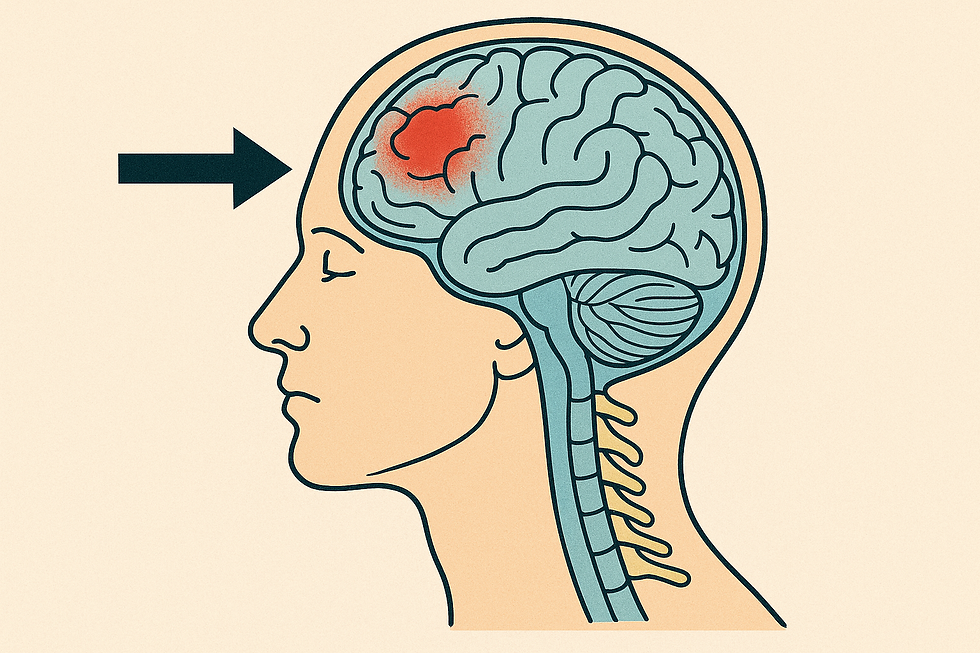
The frontal lobes sit at the front of the brain, directly behind the forehead. They can be injured when the head strikes an object, when the brain moves inside the skull, or when acceleration, deceleration and rotational forces stretch and damage brain tissue.
Motor vehicle collisions, motorcycle crashes, pedestrian impacts, bicycle crashes, falls and assaults can all injure the frontal regions of the brain.
Some injuries are visible on CT or MRI. Imaging reports may describe frontal contusions, hemorrhagic contusions, traumatic subarachnoid hemorrhage, intraparenchymal hemorrhage, edema, encephalomalacia, gliosis or microhemorrhages. In other cases, routine imaging may not fully explain the person’s executive dysfunction.
Frontal and temporal contusions are common in head trauma because the brain can strike the irregular bony surfaces inside the skull. A person can also suffer a coup-contrecoup injury, where the brain is injured at the point of impact and on the opposite side as it moves within the skull.
For more detail about traumatic imaging terminology, see our guide to what MRI and CT scans show after a traumatic brain injury.
What Behaviour Changes Can Follow a Frontal Lobe TBI?
Frontal lobe injuries can affect behaviour in ways that are obvious to family members but difficult to capture in a short appointment.
Some people become more irritable and reactive. Small frustrations can lead to disproportionate anger. The person may interrupt, swear, argue, walk away from responsibilities or react badly to normal feedback.
Others suddenly become very impulsive. For example, they might make unsafe choices, spend money without thinking, drive aggressively, ignore medical advice, take unnecessary risks or say things they would never have said before the injury.
Some people become apathetic instead. They may sit for long periods, fail to initiate tasks, neglect hygiene, avoid responsibilities, stop participating in family life or appear emotionally flat. This can be mistaken for laziness or depression when it is actually part of the brain injury picture.
Frontal lobe injury can also affect social judgment. A person may miss cues, speak inappropriately, make offensive comments, show reduced empathy or behave in ways that damage relationships. The injured person may not understand why others are upset.
These symptoms can be especially painful for families because the person may look like the same person physically, while acting very differently in daily life.
Can Someone With a Frontal Lobe Injury Look Normal?
Yes. This is one of the most difficult parts of frontal lobe brain injury. Thos suffering with frontal lobe damage may walk normally, speak normally and perform well in a short conversation. They may know the date, answer basic questions and appear polite during a medical appointment.
The problems often emerge under real-world demands: returning to work, managing fatigue, organizing a day, handling criticism, caring for children, remembering appointments, controlling anger, managing money or adapting when something unexpected happens.
This gap between appearance and function can lead to serious misunderstanding. Employers may believe the person is being difficult. Family members may feel they are dealing with a different personality. Insurers may point to normal conversation or normal physical appearance while ignoring how the person functions over a full day or week.
Why Frontal Lobe Injury Can Be Hard to Prove
Frontal lobe impairments can be hard to prove because it is often behavioural and situational. Scans could show a frontal contusion or other structural injury. That helps. But imaging does not always capture the full extent of executive dysfunction, and a normal or limited scan does not answer every question about behaviour, insight and real-world performance.
The injured person may also lack insight. They may deny problems, minimize changes or become angry when family members describe the difference. That lack of awareness can itself be part of the injury.
Important evidence can come from people who knew the injured person before and after the accident. A spouse, parent, adult child, friend, employer or coworker may be able to describe changes in patience, judgment, reliability, emotional control, social behaviour, motivation or ability to manage responsibilities.
Work records can be powerful. A person who was reliable, organized and calm before the accident may now miss deadlines, react poorly to supervision, forget steps, argue with coworkers or become overwhelmed by normal tasks.
How Neuropsychological Testing Assesses Executive Dysfunction
Neuropsychological testing is important if a frontal lobe injury appears to affect thinking, behaviour or work capacity.
Neuropsychologists are capable of assessing attention, processing speed, memory, executive function, problem-solving, inhibition, mental flexibility and emotional functioning. Testing can help identify whether the person’s difficulties are consistent with frontal systems dysfunction, another cognitive pattern, psychological injury, pain, fatigue or a combination of factors.
Executive dysfunction is not always easy to measure. Some office-based tests do not fully reproduce the demands of a workplace, household or parenting environment. That is why neuropsychological evidence is often strongest when considered together with occupational therapy records, rehabilitation evidence, family observations and employment history.
For more detail, see our guide to neuropsychological assessments in Ontario brain injury claims.
How Frontal Lobe Injuries Can Affect Work
Frontal lobe injury can seriously interfere with employment even where the person has recovered physically. Work requires more than showing up. It requires planning, pace, attention, emotional control, judgment, memory, initiative, communication, flexibility and the ability to accept feedback. Frontal lobe damage can affect all of these.
A person might seem to struggle to start tasks, organize files, manage deadlines, stay on topic, shift between tasks, control frustration or recognize mistakes. They may become slower, more rigid, more impulsive or less reliable. They may also fatigue quickly because executive tasks require far more mental effort than before.
Some people can return to a simplified role but cannot manage their former job. Others can work for a short period and then deteriorate as fatigue builds. Some lose employment because behavioural changes are misunderstood as attitude problems rather than brain injury consequences.
This is why employment evidence is important. Performance reviews, attendance records, failed return-to-work attempts, accommodation requests and coworker observations can help show how frontal lobe symptoms affect actual work capacity.
How Frontal Lobe Injury Can Affect Independence and Family Life
Frontal lobe injuries can change life at home as much as life at work. A person could forget bills, miss appointments, leave appliances on, make impulsive purchases, neglect medication, drive unsafely or become overwhelmed by ordinary household responsibilities. They may need reminders, supervision, external structure or help from family members to stay safe and organized.
Family relationships often become very strained. A spouse may feel they have become a caregiver. Children may be frightened by anger outbursts or confused by emotional flatness. The injured person may not recognize the burden they are placing on others.
Why Frontal Lobe Injury Matters in an Ontario Brain Injury Claim
Frontal lobe brain injury can affect the medical, functional and damages evidence in an Ontario brain injury claim.
The claim should not focus only on the diagnosis or scan result. It should address how the injury changed the person’s behaviour, work capacity, family role, independence and safety. The strongest evidence often comes from a combination of medical records, imaging, neuropsychological testing, occupational therapy evidence, employment records and before-and-after witness evidence.
Where frontal lobe injury affects judgment, impulse control or insight, the injured person may also underestimate their own problems. That makes collateral evidence from family, employers and treatment providers even more important.
Foster Injury Law represents people throughout Ontario who have suffered traumatic brain injuries affecting cognition, behaviour, personality and independence. Our Ontario brain injury lawyers review the medical and functional evidence needed to show the full effect of a serious brain injury.
We are able to offer free consultations and do not charge legal fees unless the claim is successfully resolved.
Frequently Asked Questions About Frontal Lobe Brain Injuries
Can a brain injury change someone’s personality?
Yes. A traumatic brain injury affecting the frontal lobes can change personality, judgment, emotional regulation, impulse control and social behaviour. Family members often notice changes before they are fully captured in medical records.
Can frontal lobe damage cause anger or irritability?
Yes. Frontal lobe damage can affect emotional regulation and impulse control. A person may become more reactive, impatient, argumentative or prone to anger outbursts after the injury.
Can frontal lobe injury make someone impulsive?
Yes. The frontal lobes help control inhibition and decision-making. After a frontal lobe TBI, a person may make unsafe choices, spend impulsively, interrupt others, ignore consequences or behave in ways that are out of character.
Can someone with a frontal lobe brain injury look normal?
Yes. A person with frontal lobe injury may look physically recovered and speak normally during short conversations. Their difficulties often become clearer in real life, where they must manage work, family responsibilities, judgment, fatigue and unexpected problems.
How is frontal lobe damage tested after a TBI?
Assessment could potentially include neurological examination, CT or MRI imaging, neuropsychological testing, occupational therapy assessment and evidence from family members or employers. No single test captures every real-world effect.
Can a frontal lobe injury affect work capacity?
Yes. Frontal lobe injuries affect planning, organization, attention, emotional control, judgment, reliability and ability to handle feedback. These problems can make it difficult to return to the same job even when the person appears physically recovered.
Can family evidence help prove personality changes after brain injury?
Yes. Family members often provide important evidence because they can compare the person before and after the accident. Their observations can help show changes in patience, judgment, motivation, emotional control, social behaviour and independence.
Can frontal lobe injury affect independent living?
Yes. A person with frontal lobe injury may need help with medication, finances, appointments, household safety, driving decisions or daily structure. The need for support can exist even where the person can walk, talk and perform basic self-care.
Updated June 2026


