
How Motorcycle Accident Claims Progress in Ontario
Updated: April 2026
Quick Answer:
Motorcycle accident claims in Ontario move through a number of stages, starting with Accident Benefits and early insurer involvement, then shifting into liability investigation, medical recovery, and eventually settlement or litigation. Most claims take time because doctors need a clearer understanding of the long-term prognosis before the case can be properly valued, and early settlement offers rarely reflect the full extent of the damages.
At the beginning, everything moves quickly. There are forms to complete, appointments to attend, and regular contact with the insurer. Then, after a few months, it often feels like things have slowed down.
That shift is where most confusion comes from. The file hasn’t stalled. It has just moved into a stage where the important questions can’t be answered yet.
Right after the accident
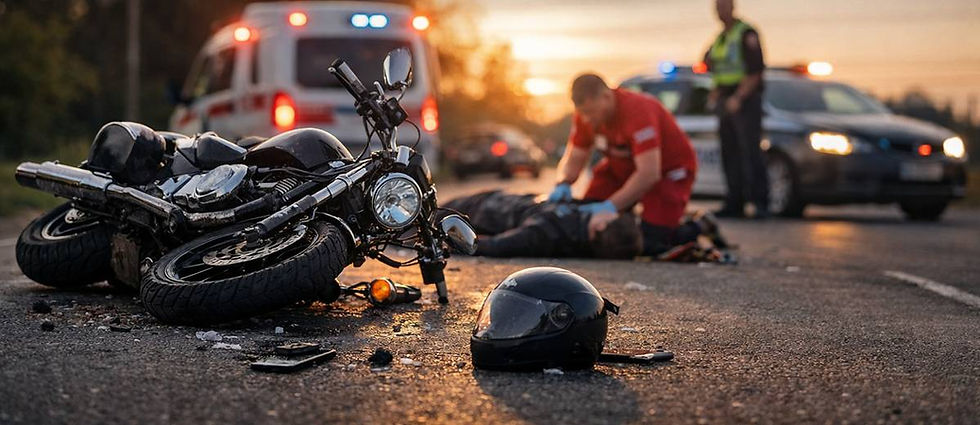
The first stage is mostly practical. You are dealing with treatment, reporting the accident, and notifying your insurer. Most people are focused on getting through the immediate situation, not thinking about how a claim might look a year or two down the road.
Even so, what happens here can matter later. How injuries are described early on, whether anything is documented, and whether there are photos or witnesses can all become relevant as the claim develops.
Accident Benefits and early insurer involvement
Once the Accident Benefits claim is opened, the insurer becomes more actively involved. Treatment plans are submitted. Some are approved, others are not. Income replacement may begin. Assessments may be scheduled.
At the same time, the insurer is forming an early view of the file. How serious the injuries appear, whether recovery seems likely, and what the claim might be worth.
Those early impressions are often based on limited information, but they can influence how the file is handled going forward.
Early settlement discussions
Insurers are generally open to resolving claims at any stage. However, early offers are typically based on the assumption that the injuries will improve and that the long-term impact will be limited.
The difficulty is that, at that point, there usually isn’t enough information to know whether that assumption is correct.
A claim that looks relatively straightforward in the first few months can look very different a year later. If it is resolved too early, that difference is never accounted for.
How fault is assessed
While all of this is happening, fault is being evaluated in the background.
That typically involves the police report, witness statements, and any available physical or video evidence. In more serious cases, reconstruction evidence may be used to better understand how the collision occurred.
If you want a more detailed breakdown of that process, you can refer to the motorcycle accident liability guide.
Early positions on fault are often taken at this stage. They are not always the final positions.
Treatment and the longer-term picture
This is where most claims spend the majority of their time. Treatment continues, and over time a clearer picture starts to form. Some injuries improve. Others do not. In some cases, new issues become apparent that were not obvious early on.
From a legal perspective, the key issue is not just the injury itself, but what a person's ultimate functional status will be for the remainder of their lifetime.
Doctors are usually hesitant about giving a firm prognosis within the first two years of a serious injury case. In many cases, particularly within the first couple of years, they will say that it is still unclear whether symptoms will resolve or become permanent.
That uncertainty makes it difficult to properly value a claim. Until there is a clearer sense of the long-term outcome, any numbers attached to the file are based on assumptions.
Building the claim
As the medical picture becomes more defined, the financial side of the claim starts to take shape.
Income loss can be supported with actual records. Future earning capacity can be assessed more realistically. Ongoing treatment needs and potential future care can be evaluated based on medical input rather than early expectations.
This is the stage where the claim moves from estimates to evidence.
If you want a more detailed explanation of how compensation is assessed, you can refer to the motorcycle accident settlement guide.
When a lawsuit is started
If the claim is not resolving, a motorcycle accident lawsuit may be started.
That step does not mean the case is going to trial. Most cases still settle. What it does is put a more formal structure around the process and require both sides to fully engage with the claim.
Documents are exchanged, and each side sets out its position more clearly. The Plaintiff is often providing significant amounts of medical records from both before and after the collision. They will often also provide tax returns, employment files, and other employment information.
Discovery
Discovery is often the first point where the claim is tested in a meaningful way.
You are questioned under oath about the accident, your injuries, and how your situation has changed. The insurer has an opportunity to assess your evidence directly, rather than through reports or summaries.
In many cases, this is where earlier assumptions start to break down. Issues that seemed minor may take on more importance, and positions on both sides can shift.
Mediation
Many motorcycle accident claims resolve at mediation. By this stage, there is usually enough information for both sides to properly assess the case. The medical evidence is more complete, the financial impact is clearer, and the risks of going further are better understood. Accident reconstructions will have been completed, if necessary.
Settlement discussions at this point are generally more grounded. They are based less on assumptions and more on the actual evidence.
Geographic Consideration
There are specific geographic considerations to how claims progress as well. For example, Toronto motorcycle accident cases require mandatory mediation whereas Barrie motorcycle cases do not. Hotly disputed Brampton motorcycle cases are known to take longer than cases in more remote areas due to severe court backlogs in Brampton.
Trial
Only a small number of cases go to trial. However, settlement decisions are made based off what parties believe will happen if a trial occurs.
At trial, a judge or jury makes the final decision based on the evidence. The uncertainty involved in the outcome is often what drives resolution at earlier stages.
Why these claims don’t always move quickly
Most delays come down to one issue: the important questions have not been answered yet. Early in the claim, there is usually an assumption that recovery will be straightforward. Over time, that assumption is either confirmed or it is not.
Doctors need time before they can say whether symptoms are likely to resolve. Without that, it is difficult to assess future care needs or long-term limitations.
Until the medical picture becomes clearer, the claim tends to remain in that middle stage where it is still developing. Moving it forward too quickly usually means relying on incomplete information.
What this means in practice
If a claim feels slow, it is often because it has reached a stage where more information is needed before anything meaningful can happen. That is not necessarily a problem. In many cases, it is what allows the claim to be properly developed and valued.
Final thoughts
Motorcycle accident claims are not just about what happened at the time of the collision. They are about the long-term impact of the injuries.
In practice, the difference between a weak result and a strong one often comes down to whether the claim was resolved before that long-term picture became clear.
FAQ
Why won’t medical experts provide a clear prognosis yet?
Because recovery is still ongoing. In many cases, it takes up to two years before doctors are comfortable saying whether symptoms will resolve or continue.
Should I accept an early settlement offer?
Only once you understand the long-term impact of your injuries. Early offers are often based on assumptions about recovery.
What happens at discovery?
You are questioned under oath about the accident and your injuries. It is a key step in assessing the strength of the claim.
Do most cases go to trial?
No. Most claims resolve before trial, often at mediation.
Why does my case feel slow?
Usually because the medical evidence is still developing and the long-term impact is not yet clear.
Disclaimer: This article is for general information only and does not constitute legal advice. Every motorcycle accident claim depends on its specific facts.


